Distributed Fiber Optic Leak Detection
Continuous monitoring for accurate detection and localization of water leaks across dams, dykes and water containment infrastructure.
Distributed Fiber Optic Leak Detection
Water containment structures such as dams, dykes and water channels are critical infrastructure assets where undetected leakage can develop into a significant operational and structural concern.
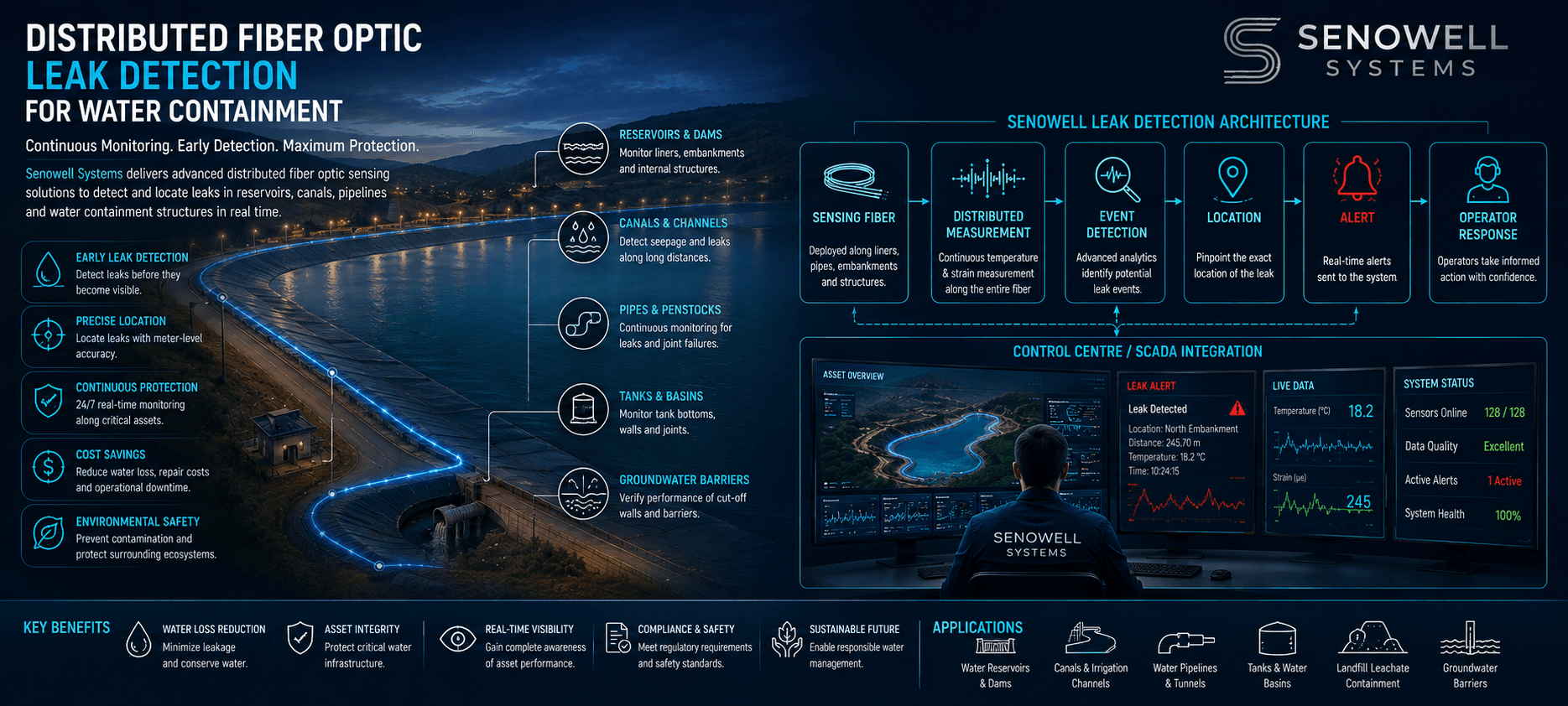
Senowell Systems provides Distributed Fiber Optic Leak Detection solutions designed to identify and locate water leakage using distributed temperature sensing technology. Instead of relying solely on individual point sensors, distributed fiber optic sensing provides monitoring along the length of the sensing cable, allowing engineers to obtain information about where a potential leakage event is occurring.
Accurate Leak Detection and Localization
The key advantage of distributed fiber optic leak detection is the ability to identify the location of a potential leak along the monitored structure. This provides infrastructure operators with more useful information than a simple leak alarm. The monitoring system can help identify the affected section, supporting targeted inspection and maintenance.
Distributed Temperature Sensing The leak detection solution uses Distributed Temperature Sensing (DTS) technology. Changes associated with water leakage can produce a detectable thermal response around the sensing cable. Distributed temperature measurements can therefore be used to identify potential leakage locations along water containment infrastructure.
Monitoring Water Containment Infrastructure
Senowell Systems' distributed leak detection solutions can be applied to: Dams Dykes Water channels Water containment structures Other suitable linear water infrastructure
Continuous Monitoring Along the Asset
Conventional point-based monitoring only provides information at the locations where individual sensors have been installed. Distributed fiber optic sensing takes a different approach by using the fiber as a continuous sensing medium. This enables a monitoring system to cover extended sections of infrastructure and identify where changes are occurring along the monitored route.
Early Identification of Leakage
Early identification of water leakage can help infrastructure operators investigate developing problems before they become more difficult to manage. By continuously monitoring the sensing fiber, operators can receive information about changes occurring along the monitored structure and direct inspection resources toward areas requiring further investigation.
Long-Range Infrastructure Monitoring
Distributed fiber optic sensing is particularly valuable for large or linear infrastructure where monitoring many individual points can become complex. The source application identifies the long-range capability of the technology as an advantage for infrastructure monitoring. The achievable monitoring distance and performance depend on the selected interrogator, sensing cable, installation design and project configuration.
Integration with Structural Health Monitoring
Distributed leak detection can form part of a wider Structural Health Monitoring (SHM) and infrastructure asset-management strategy. Combining distributed temperature monitoring with other sensing technologies can provide infrastructure owners with a broader understanding of asset condition and environmental behaviour.
Key Benefits:
Distributed water leak detection Leak location identification Distributed Temperature Sensing (DTS) Long-distance infrastructure monitoring Continuous monitoring along sensing fiber Reduced dependence on point sensors Suitable for dams and dykes Suitable for water channels Supports targeted inspection Supports condition-based maintenance Integration into wider infrastructure monitoring systems
Finding Water Leaks Before They Become a Bigger Infrastructure Problem
Water leakage in dams, dykes and other containment structures may develop at locations that are difficult to inspect directly. Traditional inspection methods can require extensive manual investigation, particularly when the location of a leak is unknown.
A distributed fiber optic monitoring system provides a different approach by monitoring temperature along the sensing cable and helping identify the location associated with a potential leakage event.
This allows infrastructure operators to focus inspection and maintenance activities on areas where the monitoring system indicates an abnormal condition.
Applications:
Dam Leak Detection:
- · Distributed fiber optic temperature monitoring for detecting and locating potential water leakage in dam structures.
Dyke Leak Detection:
- · Monitor dykes and containment embankments using distributed temperature sensing to identify potential leakage along the monitored structure.
Water Channel Monitoring:
- · Monitor water channels and linear containment infrastructure for potential leakage using distributed fiber optic sensing.
Water Containment Monitoring:
- · Continuous distributed monitoring for water containment structures where early identification and localization of leakage are important.
Infrastructure Condition Monitoring:
- · Integrate distributed leak detection into a broader infrastructure monitoring strategy to support condition assessment and targeted maintenance.
Civil Infrastructure Monitoring:
- · Apply distributed fiber optic sensing to critical civil infrastructure where long-distance monitoring and event localization are required.
Assets:
- Dams
- Dykes
- Water Channels
- Water Containment Structures
- Water Infrastructure
- Civil Infrastructure
- Hydraulic Infrastructure
Downloads
Senowell Fiber Optic Dams & Water Infrastructure Monitoring
Brochure • 256 KB
Frequently Asked Questions
Contact us
Submit your inquiry and we will contact you