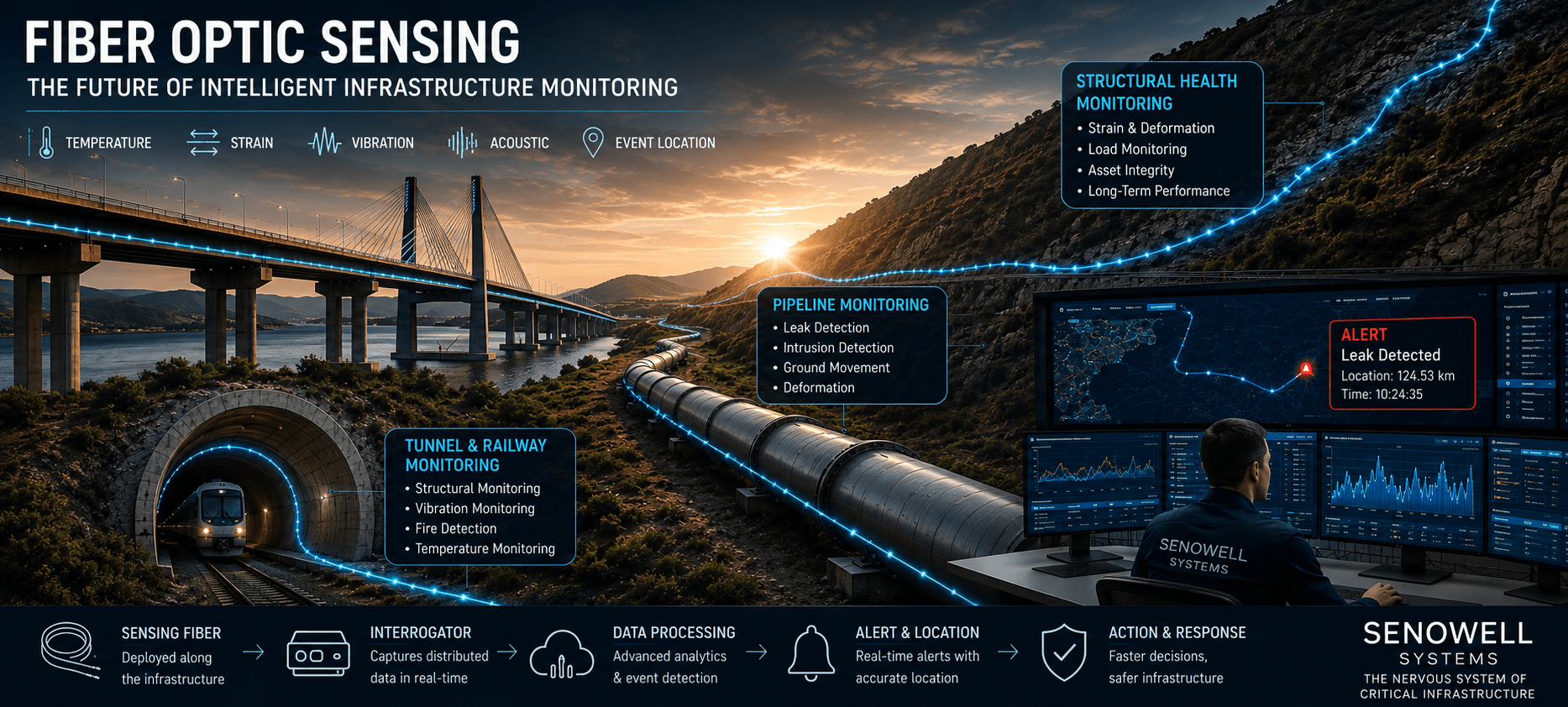
Fiber Optic Sensing: The Future of Intelligent Infrastructure Monitoring
Critical infrastructure is constantly exposed to changing loads, temperature, vibration, ground movement and environmental conditions. Bridges experience traffic loads, pipelines face pressure and ground movement, tunnels are exposed to geological forces, and railway infrastructure experiences continuous vibration. Traditionally, monitoring these assets has required individual sensors installed at specific locations.
Fiber optic sensing changes this approach.
Instead of monitoring only selected points, a fiber optic sensing system can turn an optical fiber into a continuous sensing element, allowing engineers to monitor conditions across long sections of infrastructure.
At Senowell Systems, we see fiber optic sensing as more than a sensor technology. It is a way of creating a continuous nervous system for critical infrastructure.
What Is Fiber Optic Sensing?
Fiber optic sensing uses changes in light travelling through an optical fiber to measure physical conditions. Depending on the sensing technology and interrogator, fiber optic systems can be used to monitor parameters such as:
✓ Temperature
✓ Strain
✓ Deformation
✓ Vibration
✓ Acoustic activity
✓ Ground movement
The major advantage is that the sensing fiber can extend over significant distances, allowing a single monitoring architecture to cover infrastructure that would otherwise require large numbers of conventional sensors. From Point Sensors to Distributed Sensing A conventional monitoring system might place sensors at predetermined locations: Sensor → 10 m → Sensor → 10 m → Sensor → 10 m → Sensor
This can work well when the location of a potential problem is already known. But infrastructure does not always behave according to the locations we choose to monitor. A crack, deformation, leak or abnormal vibration can occur between two conventional sensors.
Distributed fiber optic sensing provides a different approach: Continuous Fiber → Continuous Monitoring → Event Location
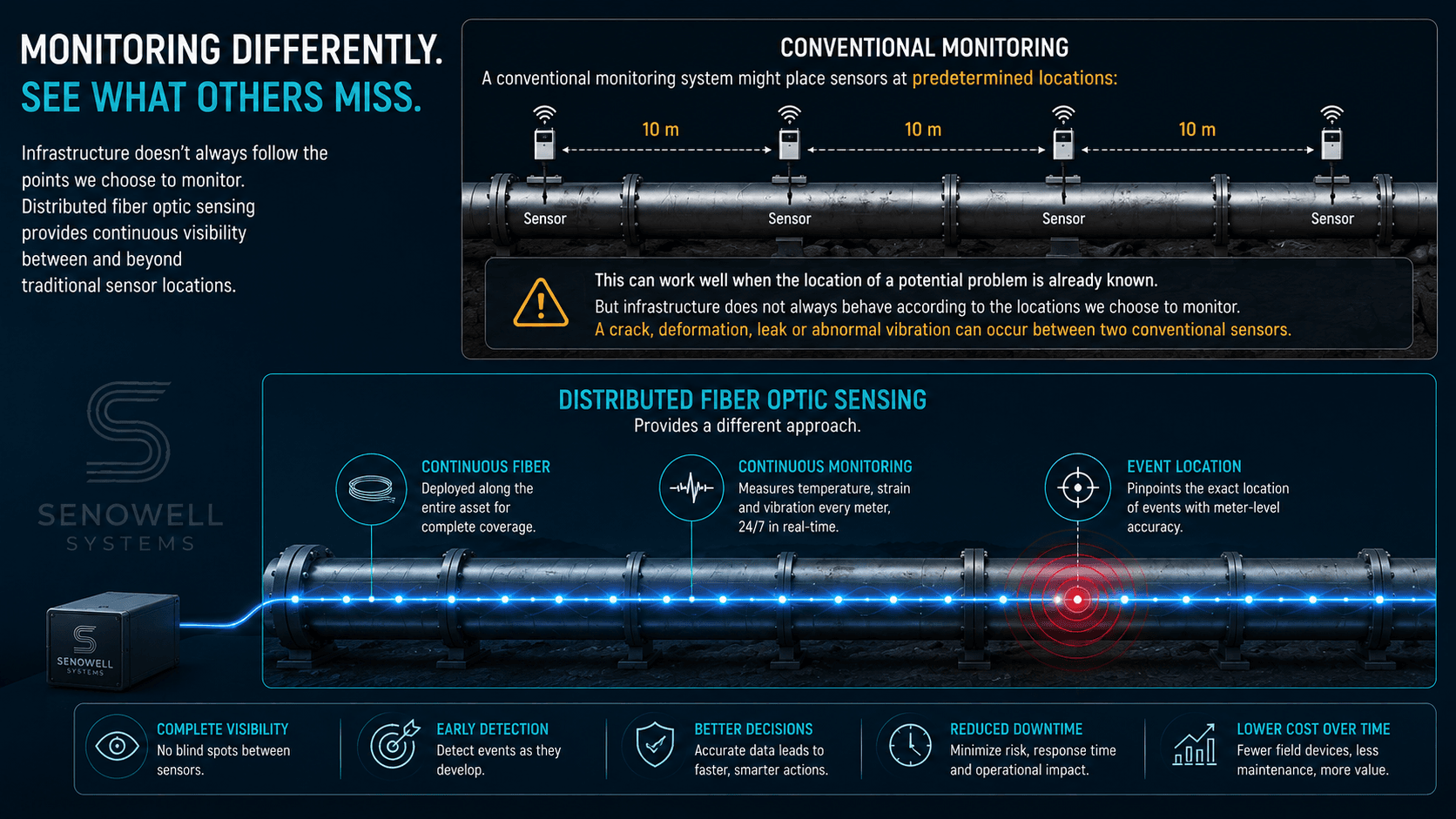
Instead of asking: Is something happening at this sensor?"
engineers can ask: "What is happening along the entire monitored section, and where is it happening?"
How Distributed Fiber Optic Sensing Works
A distributed fiber optic monitoring system typically consists of three major components:
1. Sensing Fiber
The optical fiber is installed along or within the infrastructure being monitored.
Depending on the application, the fiber may be installed on bridges, pipelines, tunnels, railway infrastructure, dams, slopes or other assets.
2. Interrogator
The interrogator sends optical signals into the fiber and analyses the returning light. The resulting information can be used to determine changes in temperature, strain, vibration or acoustic activity.
3. Monitoring & Data Platform
The measurement data is processed and presented through monitoring software, dashboards or integrated control systems. This allows engineers and operators to move from raw sensor data toward events, alarms and actionable information.
What Can Fiber Optic Sensing Monitor?
Different distributed sensing technologies are suited to different monitoring requirements.
Distributed Temperature Sensing
Distributed Temperature Sensing, or DTS, measures temperature along the optical fiber. It can be used for applications such as:
Fire detection
Cable temperature monitoring
Pipeline monitoring
Leak detection
Industrial temperature monitoring
For long infrastructure such as tunnels, pipelines and cable routes, distributed temperature monitoring can provide information across the entire monitored section.
Distributed Strain Sensing
Distributed strain sensing measures changes in deformation along the sensing fiber. This can be particularly valuable for Structural Health Monitoring.
Applications can include:
Bridges
Tunnels
Dams
Buildings
Pipelines
Rail infrastructure
Geotechnical structures
By observing how strain changes over time, engineers can better understand how an asset responds to loading, temperature and environmental conditions.
Distributed Acoustic Sensing
Distributed Acoustic Sensing (DAS) uses optical fiber to detect acoustic and vibration activity along the monitored route. This opens up applications such as:
Pipeline intrusion detection
Excavation detection
Railway monitoring
Perimeter monitoring
Infrastructure security
Acoustic event detection
For long linear infrastructure, DAS can provide a continuous monitoring layer without requiring conventional electronic sensors to be installed at every location.
Fiber Optic Sensing for Structural Health Monitoring
One of the most powerful applications is Structural Health Monitoring (SHM). Infrastructure owners need to understand how structures behave not only during construction, but throughout their operational life.For a bridge, for example, distributed fiber optic sensing can help monitor changes in strain and deformation across structural elements. For a tunnel, sensing can provide information about changes in the surrounding structure and ground conditions. For a dam, distributed monitoring can support the detection of deformation and other changes affecting the asset.
The objective is not simply to collect more data.
The objective is to understand the condition of the infrastructure before a small change becomes a major problem.
Fiber Optic Pipeline Monitoring
Pipelines are among the strongest applications for distributed fiber optic sensing because they can extend across hundreds of kilometres. A single monitoring architecture can potentially provide information about multiple threats along the pipeline route. Depending on the sensing technology, these can include:
✓ Leak-related temperature changes
✓ Acoustic events
✓ Third-party excavation
✓ Ground movement
✓ Landslides
✓ Pipeline deformation
✓ Soil erosion
Combining distributed temperature, strain and acoustic sensing can provide pipeline operators with a broader view of asset condition and surrounding activity.
Fiber Optic Monitoring for Tunnels & Railways
Tunnels and railway infrastructure present unique monitoring challenges.
They are often long, difficult to access and exposed to continuous mechanical and environmental stresses.
Fiber optic sensing can provide a continuous monitoring layer across these environments.
For tunnels, applications can include:
Fire detection
Structural monitoring
Temperature monitoring
Ground movement
Acoustic monitoring
For railway infrastructure, distributed sensing can help monitor vibration, temperature and structural behaviour along the track or associated infrastructure.
Why Fiber Optic Sensing Is Important for Critical Infrastructure
The biggest advantage of fiber optic sensing is not simply the fiber itself. It is the scale of information that can be obtained from a single sensing architecture. Critical infrastructure can be kilometres long, constantly changing and difficult to inspect manually.
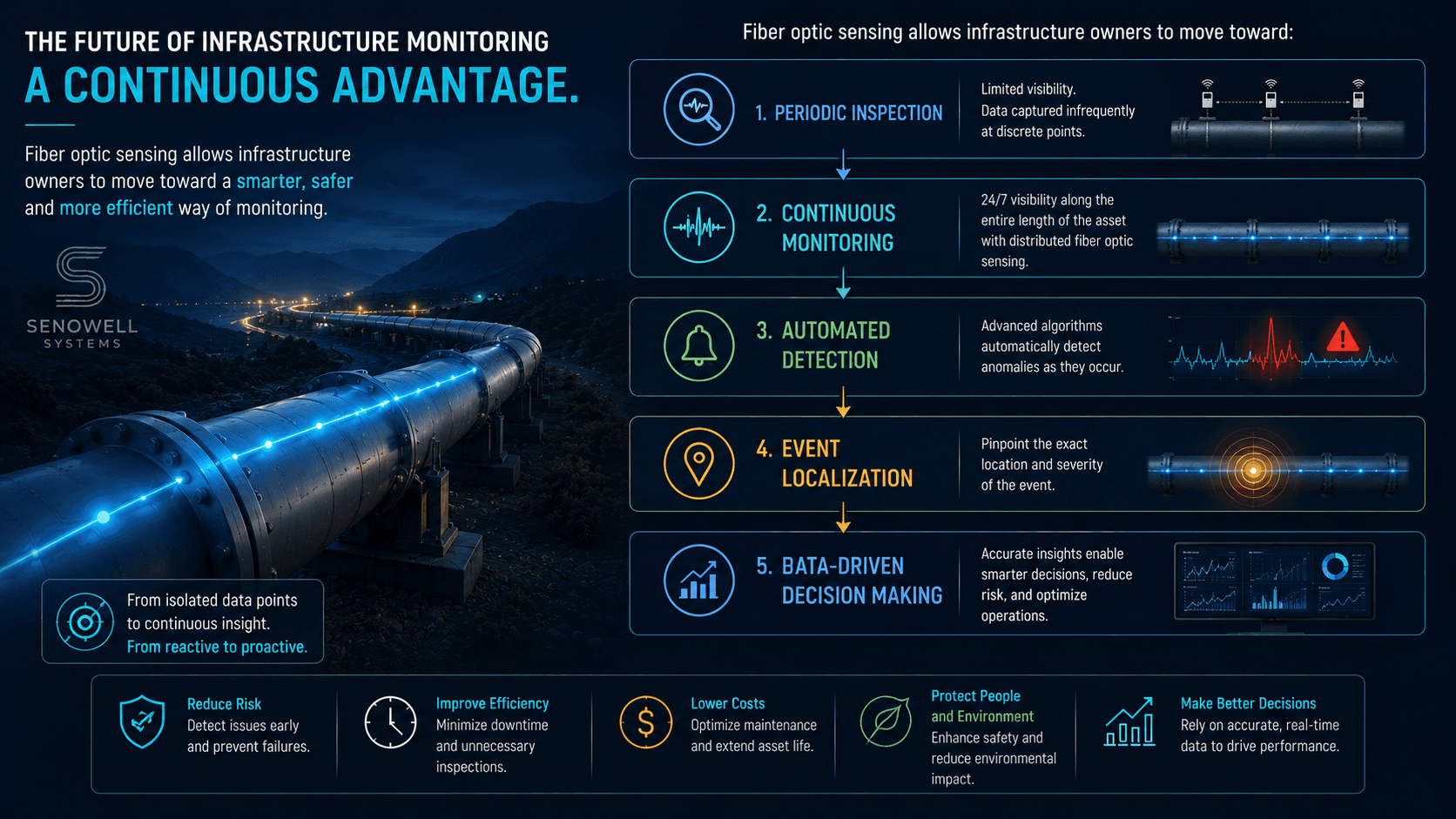
This is an important shift in the way infrastructure can be managed. From Sensors to an Infrastructure Nervous System At Senowell Systems, we believe the future of infrastructure monitoring is not about installing more disconnected sensors. It is about creating an intelligent sensing layer across the asset. The concept is similar to the human nervous system.
The fiber acts as the sensing network.
The interrogator acts as the measurement system.
The software acts as the processing layer.
And the monitoring platform becomes the interface through which engineers understand what is happening.
Together, these components can create a continuous digital representation of infrastructure behaviour.
The Senowell Systems Approach
Senowell Systems brings together fiber optic sensing, Structural Health Monitoring, engineering integration and intelligent monitoring to help asset owners understand the condition of critical infrastructure.
Our solutions can be designed around applications including:
Structural Health Monitoring
Bridges, tunnels, dams and civil structures.
Pipeline Monitoring
Leak detection, intrusion monitoring, deformation and ground movement.
Geotechnical Monitoring
Ground movement, landslide detection and infrastructure stability.
Railway Monitoring
Temperature, vibration and structural behaviour.
Fire Detection
Distributed temperature monitoring across tunnels, cable routes and other critical environments.
The sensing technology is only the beginning.
Our objective is to connect sensing → data → analysis → alerts → action.
The Future of Infrastructure Monitoring
As infrastructure becomes older, more heavily used and increasingly complex, continuous monitoring will become more important.Fiber optic sensing provides a foundation for this transition. Instead of waiting for an inspection to reveal a problem, infrastructure owners can continuously observe how their assets are behaving.
Instead of asking where a problem might be, distributed sensing can help identify where a change is occurring. And instead of treating sensors as isolated devices, they can become part of a connected infrastructure monitoring system.
The future of infrastructure is not just connected. It is sensed.
Conclusion:
Fiber optic sensing is transforming the way engineers monitor critical infrastructure.
Its ability to provide distributed temperature, strain, acoustic and vibration information makes it particularly valuable for long and complex assets such as bridges, pipelines, tunnels, railways, dams and geotechnical structures. For infrastructure owners, the goal is simple: Detect earlier. Locate faster. Understand better. Act sooner. At Senowell Systems, we are building the sensing and monitoring infrastructure that makes this possible. The Nervous System of Critical Infrastructure.